The top insights we’ve learnt when scaling footwear e-commerce brands

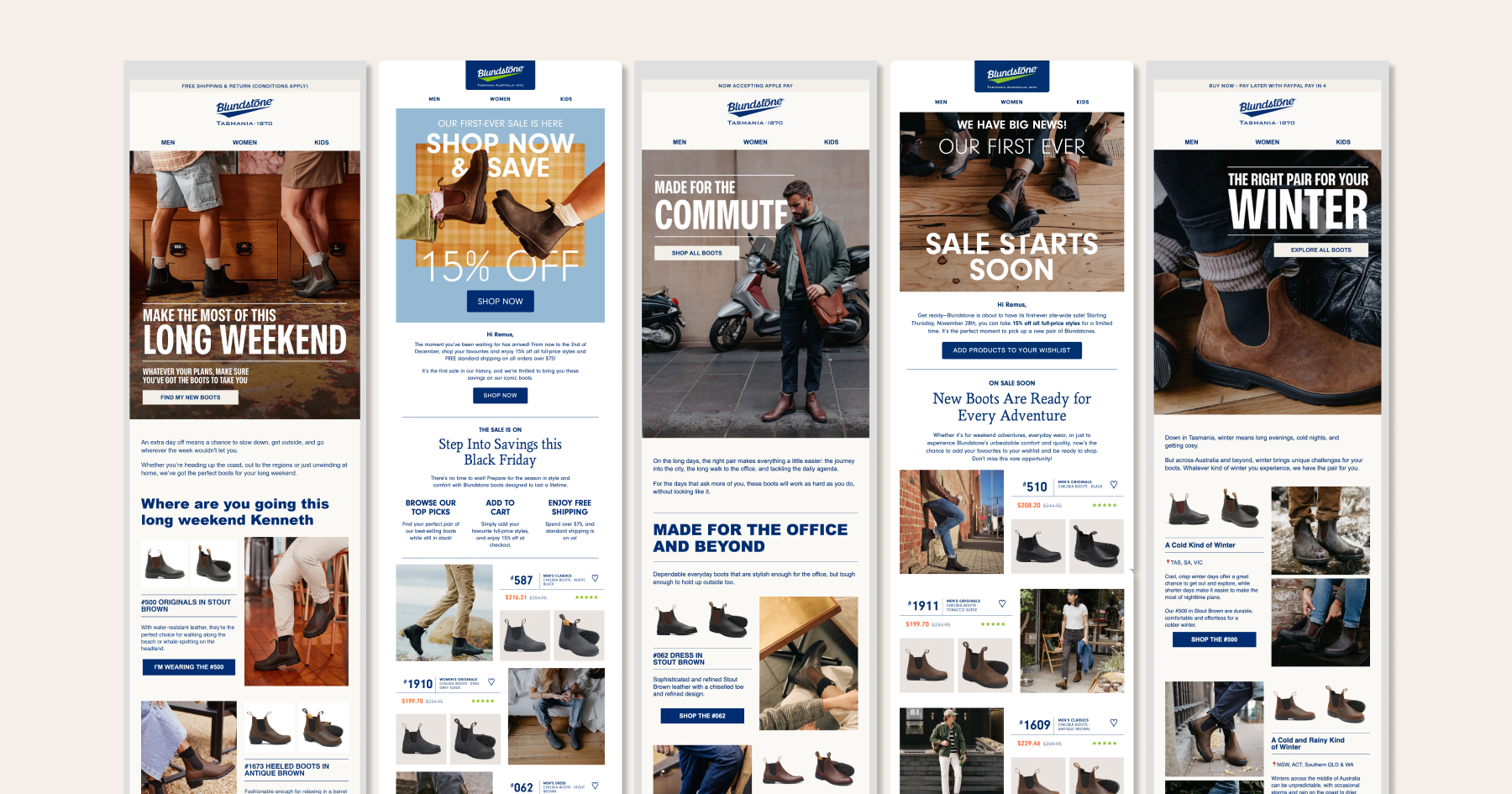
Through our experience working with global footwear brands such as Blundstone, we’ve learnt that scaling the email marketing results of footwear e-commerce brands requires a deeply personalized approach, a clear purpose and focus for each send, and an understanding of how to use timing to your advantage. This article shares some of the email marketing improvements that we have implemented with our footwear clients to help increase conversions, improve retention, and build long-term relationships with customers.
It covers the email marketing insights we have gathered through extensive practice, including how to improve segmentation, automation, lifecycle campaigns, and personalization within your strategy. It also explains how working with the right agency partner can accelerate and improve execution.
Email marketing strategies that have accelerated growth for our footwear e-commerce clients
Selling shoes online effectively requires a complete and thorough marketing strategy that spans multiple channels for maximum impact. Customers may use your website and socials to browse options, compare prices, and read reviews, but can still walk away without buying if there is friction in the customer journey or barriers to purchase: this could include a high price point, unfamiliarity with your brand, lack of information, lack of trust or shipping concerns. Email marketing allows your brand to directly address and help to remove these barriers through personal, timely, and genuinely useful communication, capitalizing on key events, both in the buyer journey (through automated flows) and in the brand’s timeline (through personalized campaign sends).
We’ve helped our clients in the footwear and fashion space grow their email revenue by over 115%, proving that email marketing is one of the highest-performing channels available to footwear e-commerce brands. Email also allows you to communicate your unique selling points directly to consumers, prioritizing what they care about: this could be community proof in the form of reviews, your brand information and values, or product information that details the craftsmanship and expertise that goes into each shoe.
The challenge with email marketing is knowing where to start and what to prioritize. Luckily, after working with 350+ e-commerce brands, we’ve become experts in setting up effective email marketing strategies for footwear brands and can help you get the most out of your email sends.
How we have grown your footwear clients using email marketing strategy
Building segmented campaigns based on shopping behavior
For our footwear clients, we have found that segmentation is one of the most effective ways to improve engagement and sales. Instead of sending the same message to every subscriber, we divide an audience based on behavior, preferences, purchase history and more, allowing for hyper-personalized sends that feel particularly relevant to the subscriber.
For our footwear client, this is particularly powerful because customers often shop with specific needs in mind.
For footwear brands, we recommend starting by building out these segments:
- Customers who purchased a particular type of shoe (e.g. running shoes)
- High-value customers (those who shop frequently)
- First-time buyers (those who need nurturing to make a purchase)
- Browsers (those who viewed products but did not purchase)
- Seasonal shoppers (those who buy during sales periods)
Through our extensive email marketing testing with our fashion and footwear clients, we’ve found that segmenting customers by engagement is particularly important. Engagement segments to build out include:
- Engaged 30 days (those who have engaged with an email in the last 30 days)
- Engaged 60 days (those who have engaged with an email in the last 60 days)
- Engaged 90 days (those who have engaged with an email in the last 90 days)
We also recommend creating engaged customer segments (meaning that a profile has both engaged with your emails and purchased a product within the specified time range) and engaged non-customers (profiles that have engaged with an email but have not yet purchased a product).
For our footwear clients, personalized campaigns have delivered significantly higher results.
Segmentation is absolutely key to our email marketing strategy development for footwear brands, as; it forms the foundation on which the rest of the email content is built.
Usinge automated flows to capture lost revenue and address friction in the customer journey
Well-designed automated flows ensure no opportunities are missed, especially when customers drop off during the buying journey. For our footwear clients, they are the highest-performing emails we send because they allow us to directly address and remove any friction or barriers to purchase, like a lack of information, lack of trust, or a price point that is too high for that customer, and deliver a targeted solution to guide them to complete their purchase.
We recommend setting up the following flows first for footwear e-commerce brands that are just getting started with email marketing:
- Abandoned cart flow: This flow reminds customers about products that they left behind in their on-site cart. Including product images, customer reviews, and a limited-time incentive can improve conversions.
- Browse abandonment flow: This flow targets users who viewed products but did not add them to their cart. A gentle reminder or curated suggestions can bring them back, directing them to purchase.
- Post-purchase flow: This flow encourages customers to leave reviews, explore related products, or join loyalty programs after they have made and received a purchase..
- Win back flow: This flow reconnects with customers who have not purchased in a while. Highlighting new arrivals or offering exclusive discounts can convince them to come back to your site to repurchase.
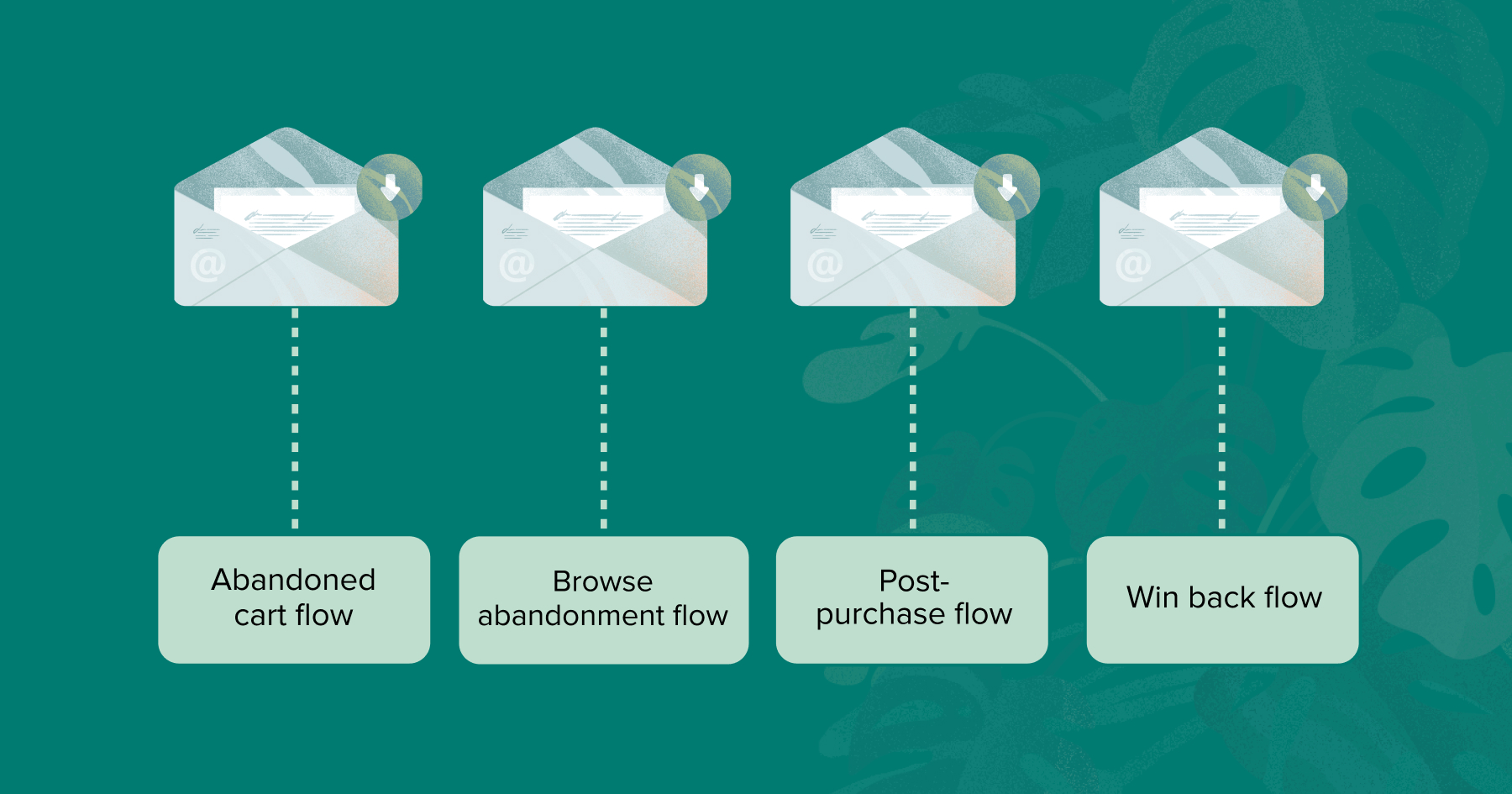
We structured email marketing flowsplan for the footwear industry in a way that ensures each communication feels relevant and timely, not repetitive. Adding logic such as time delays to your flow sequence can help ensure that your flow and other communications across your strategy work together and do not overwhelm the customer. .
Creatinge impactful copy and design that inspires purchases
Footwear is a highly visual industry, so email communications should focus on content that is impactful and inspiring, clearly communicating brand value through copy and design to customers. Instead of simply showing the products, we find the best results come from storytelling and styling ideas that help customers visualize how the footwear fits into their lives.
Content ideas that perform well for our footwear clients include:
- Seasonal lookbooks featuring new collections
- Styling guides for different occasions, such as work, travel, or fitness
- Trend updates that highlight popular designs (trends move quickly in the footwear industry)
- User-generated content showing real customers wearing your shoes
When executed well, including lifestyle content across your email marketing calendar can improve brand recall, increase revenue and increase conversions for brands in the shoe industry.
Leveraginge personalization to increase conversions
Personalization has moved from a nice addition to a core requirement across all email strategies. A key trend we’ve observed through our practise is that customers increasingly expect brands to understand their preferences and deliver relevant recommendations (and that means doing more than just adding a first name to the subject line, which many of our clients’ customers are increasingly seeing as a shallow attempt at personalization).
For footwear brands, personalization can be applied to your email marketing strategy in several ways to improve customer relationships:
- Product recommendations based on past purchases
- Size-specific suggestions to reduce friction
- Location-based messaging for weather-relevant styles
- Dynamic styles that change depending on the profile’s age, interests or predicted gender
Working with an agency that specializes in Klaviyo email marketing, like Growth Gurus, can help brands effectively implement advanced personalization using data analysis and automation tools to maximise their email marketing returns.
The goal is to make every email feel tailored to the individual’s interests and existing history with your brand, which builds trust and encourages action.
Optimizing campaigns with testing and data insights
Growth comes from continuous improvement. Testing different elements of email campaigns and flows helps us to understand what resonates with your footwear clients’ audiences and where we can optimize their strategy. This includes refining subject lines and preheaders, improving email design and layout, adjusting call-to-action placement, and improving and testing different intentions and directions behind the copy messaging.
It is also important to experiment with send times and frequency, as some footwear brands see higher engagement in the morning, while others perform better in the evening. Tracking key metrics like open rates, click-through rates, conversion rates, and revenue per email provides a clear view of performance and allows us to identify areas for improvement.
Conclusion
Email marketing remains one of the most reliable channels for scaling a footwear e-commerce brand. With the right strategy, it can drive consistent revenue, strengthen customer relationships, and build brand loyalty.
Segmentation, automation, personalization and testing each plays a critical role in building a high-performing email program. The key is to stay customer-focused and continuously refine your approach based on data.
Growth Gurus understands the unique challenges of footwear brands and helps businesses unlock the full potential of email and SMS marketing through tailored strategies and advanced automation. With the right partner and a clear plan, your brand can turn email into a powerful growth engine.
"Growth Gurus supported us with our inaugural BFCM Sale and were instrumental in us well and truly exceeding our goals. Their care and expertise makes them a wonderful partner and we're excited to continue the journey with them."
– Kate Gracie, Blundstone Australasian Marketing & Communications Manager
Frequently asked questions
Why is email marketing important for footwear e-commerce brands?

Email marketing helps footwear brands stay connected with customers, promote new products, and drive repeat purchases. It offers a direct communication channel that is not dependent on changing algorithms or paid ads.
How often should footwear brands send marketing emails?
The ideal frequency depends on your audience and campaign goals. Many brands find success with one to three emails per week, combined with automated flows that respond to customer behavior.
What type of emails generate the most sales?
Emails that combine personalization, strong visuals, and clear calls to action tend to perform best. Abandoned cart emails, product recommendations, and seasonal promotions are particularly effective.
How can I improve my email open rates?
Focus on writing engaging subject lines, segmenting your audience, and sending emails at optimal times. Personalization can also make a noticeable difference in open rates.
Recent Blog Post
.avif)

Ready to grow your business?
If you want your business to experience more sales and faster growth, all you need to do is book a meeting with us today.